Category: Business

  • India-EU Trade Deal: The “Mother of All Deals” That Will Change the Global Economy

    India-EU Trade Deal: The “Mother of All Deals” That Will Change the Global Economy

    By [Shiva Mehra,BTN24] News Desk January 28, 2026

    In a historic move that has sent ripples through the global financial markets, India and the European Union (EU) have officially signed a comprehensive Free Trade Agreement (FTA). After nearly two decades of intense negotiations, this pact—rightfully called the “Mother of All Deals”—is set to redefine India’s economic landscape and its position on the world stage.

    A New Era for ‘Made in India’

    The agreement opens the doors of the 27-nation European bloc to Indian exporters like never before. With the removal of heavy tariffs, Indian goods will now be significantly cheaper and more competitive in cities from Paris to Berlin.

    Key Sectors Set to Explode:

    • Textiles & Apparel: Indian garments will now enter Europe with Zero Duty, giving a massive boost to local weavers and factories.
    • Agriculture & Marine: Farmers and exporters of seafood, fruits, and processed foods gain direct access to a high-paying consumer base.
    • Gem & Jewellery: This sector is expected to see a 20-25% jump in exports within the first year.

    What’s in it for the Consumer? (Cheaper Luxury)

    It’s not just about exports; Indian consumers have plenty to celebrate. If you have a taste for European luxury, your shopping list just got much more affordable.

    Price Drop Alert: Expected Tariff Reductions

    Product CategoryOld Import DutyNew FTA Duty
    European Luxury Cars110%40% (Phasing to 10%)
    Wines & Spirits150%75% (Phasing to 30%)
    Chocolates & Biscuits45% – 50%0%
    High-end Machinery15%0%

    The IT & Services Boom: Jobs for the Youth

    India is often called the “Backoffice of the World,” and this deal cements that title. The FTA includes a Mutual Recognition Agreement (MRA) for professional qualifications.

    • Ease of Movement: Indian IT professionals, engineers, and healthcare workers will find it much easier to get short-term work visas for EU nations.
    • Digital Trade: Collaborative frameworks for AI and Cybersecurity mean thousands of new high-tech jobs in Bengaluru, Hyderabad, and Pune.

    The “China Plus One” Strategy

    Why now? As the world looks for a reliable alternative to China, the EU has picked India as its primary democratic partner. This deal is as much about politics as it is about money. By aligning with Europe, India secures a stable supply chain and attracts billions in Foreign Direct Investment (FDI).

    “This is more than a trade pact; it is a strategic alliance between two of the world’s largest democracies. It is a win for the Indian worker and the European consumer alike.”


    Conclusion

    The India-EU Trade Deal is a cornerstone of the Viksit Bharat 2047 vision. While there will be challenges in meeting the EU’s strict environmental and labor standards, the long-term benefits far outweigh the hurdles. For the Indian entrepreneur, the message is clear: The world is your market.v
  • U.S. Tariffs Threaten to Slow India’s Growth Story

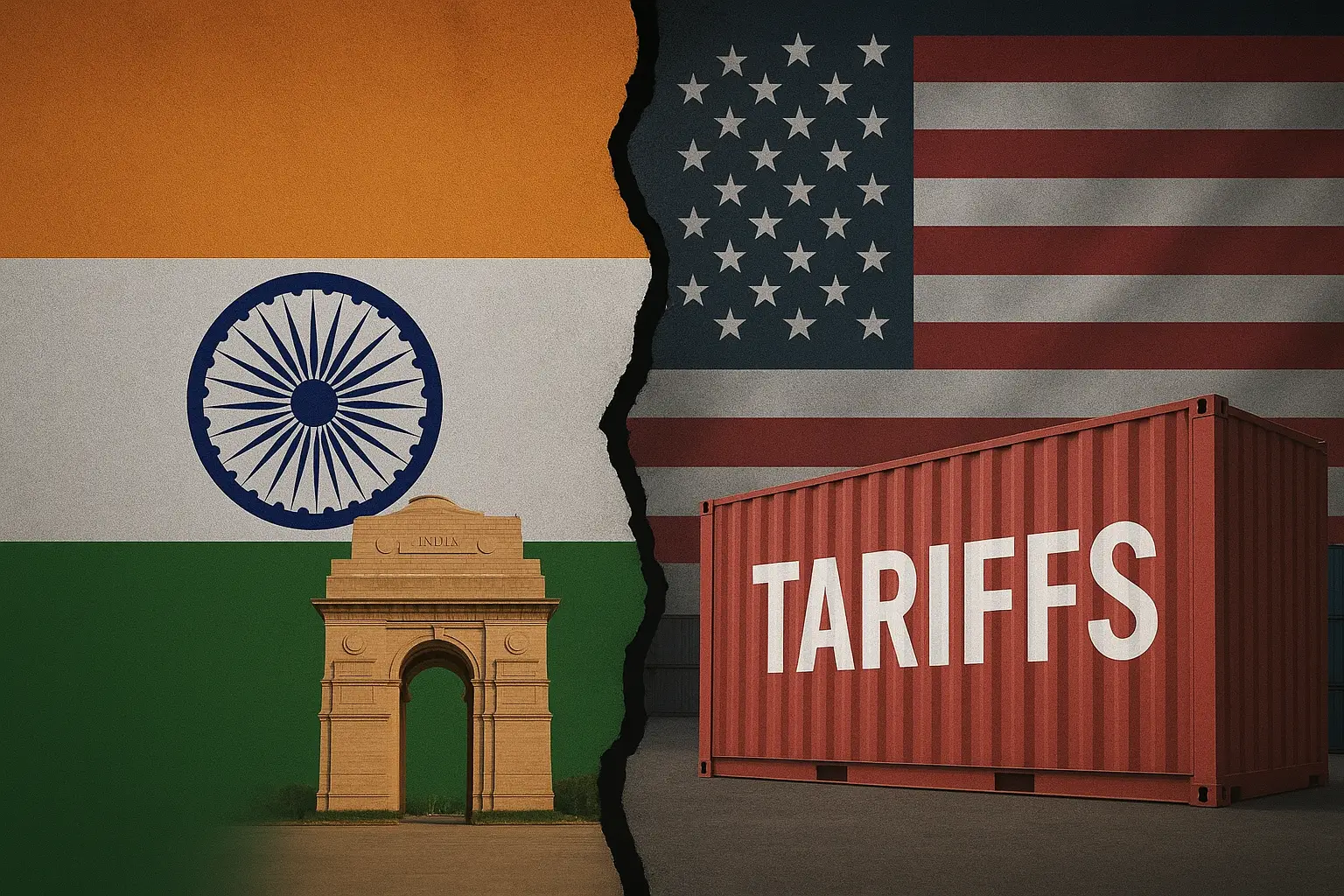
    U.S. Tariffs Threaten to Slow India’s Growth Story

    New Delhi, August 21, 2025 – For much of the past decade, India has been hailed as the world’s fastest-growing major economy, a country balancing rapid digitalization, booming consumption, and global investor confidence. But that optimism is now facing a fresh challenge: the looming threat of steep U.S. tariffs.

    The Sharpest Downgrade in Asia

    Indian companies have just recorded the steepest earnings downgrade in Asia. Analysts cut profit estimates for the next 12 months by an average of 1.2%, reflecting rising fears that American trade barriers could disrupt growth. While this figure may seem modest, the signal is powerful — global investors are beginning to lose some of their earlier confidence in the Indian market.

    Until recently, India was the top choice for Asian fund managers, ahead of China and other emerging markets. But the tariff threat has shifted sentiment. India has slipped from being seen as a “must-own” growth story to one that carries new uncertainties.

    Tariffs and Their Potential Impact

    The United States is considering tariffs of up to 50% on a broad range of imports. For India, the direct exposure might appear limited — only about 9% of corporate revenues come from the U.S. market. But the consequences go far beyond those numbers.

    Economists warn that the tariffs could shave as much as 1 percentage point off India’s GDP growth. With India currently projected to grow at around 6.5% this year, such a slowdown would be felt across industries, jobs, and household incomes.

    “Trade wars rarely stop at direct numbers. They create second-order effects: disrupted supply chains, falling investor confidence, and delayed investment decisions,” explained a senior analyst at a Mumbai-based brokerage.

    The Sectors Under Pressure

    Several sectors are already bracing for impact:

    • Automobiles: India exports a significant volume of cars and auto components to the U.S. Higher tariffs could make them uncompetitive overnight.
    • Consumer goods: From textiles and garments to electronics, many Indian companies rely on U.S. buyers. Price hikes would threaten their global market share.
    • Capital goods and machinery: With rising costs and uncertainty, Indian manufacturers risk losing contracts to Southeast Asian rivals like Vietnam and Indonesia.

    The Investor Mood Turns Cautious

    The change is visible in financial markets. Foreign portfolio investors, who pumped billions into India last year, are turning cautious. Some are reallocating funds to smaller Asian economies less exposed to U.S. trade policy.

    “India remains a growth story, but the tariff risk is now part of every investor conversation,” said a Hong Kong–based strategist.

    The Human Angle – Jobs and Livelihoods

    Beyond balance sheets and market charts, the human impact could be significant. If demand for Indian exports falls, factories producing cars, garments, and electronics may scale back operations. That could mean job losses for thousands of workers, particularly in manufacturing hubs like Gurugram, Pune, and Tiruppur.

    For small and medium enterprises (SMEs), which often supply larger exporters, the pain could be sharper. Many operate on thin margins and lack the financial cushion to absorb sudden losses. “We already work on 2-3% margins. If U.S. buyers cancel orders, we cannot survive for long,” said a textile manufacturer from Tamil Nadu.

    How India Can Respond

    Policymakers in New Delhi are aware of the risks. Three key strategies are being discussed:

    1. Strengthening Domestic Demand: With a 1.4 billion-strong population, India’s internal market is itself a powerful growth engine. Government spending and consumer incentives could help absorb external shocks.
    2. Diversifying Export Markets: Indian trade officials are intensifying talks with Europe, Africa, and Latin America to reduce reliance on the U.S. and China. Bilateral trade agreements could open new doors.
    3. Boosting Self-Reliance: Under programs like Make in India and Atmanirbhar Bharat, India is aiming to expand domestic manufacturing and reduce vulnerability to external disruptions.

    A Test for India’s Growth Dream

    For now, India’s growth story remains intact — but tested. The country’s strong digital economy, rising middle class, and infrastructure push provide resilience. Yet the global environment is becoming more complex, with protectionist trade policies threatening open markets.

    India’s challenge is to turn this crisis into opportunity. If it can strengthen its domestic economy, diversify its partnerships, and accelerate reforms, it may not only withstand the tariff shock but also emerge stronger.

    As one Delhi-based economist put it: “The tariffs are a reminder that India cannot rely solely on global goodwill. It must build resilience at home while engaging smartly abroad.”

    Conclusion

    The U.S. tariffs are more than a trade dispute — they are a stress test for India’s ambition to become the next global economic powerhouse. Whether India weathers this storm or stumbles will depend on how quickly it adapts, innovates, and protects its people from the fallout.

    For millions of Indians hoping for better jobs and rising incomes, the stakes could not be higher.

  • Indian Markets Rally on Fed Rate Cut Hopes and Cooling Inflation

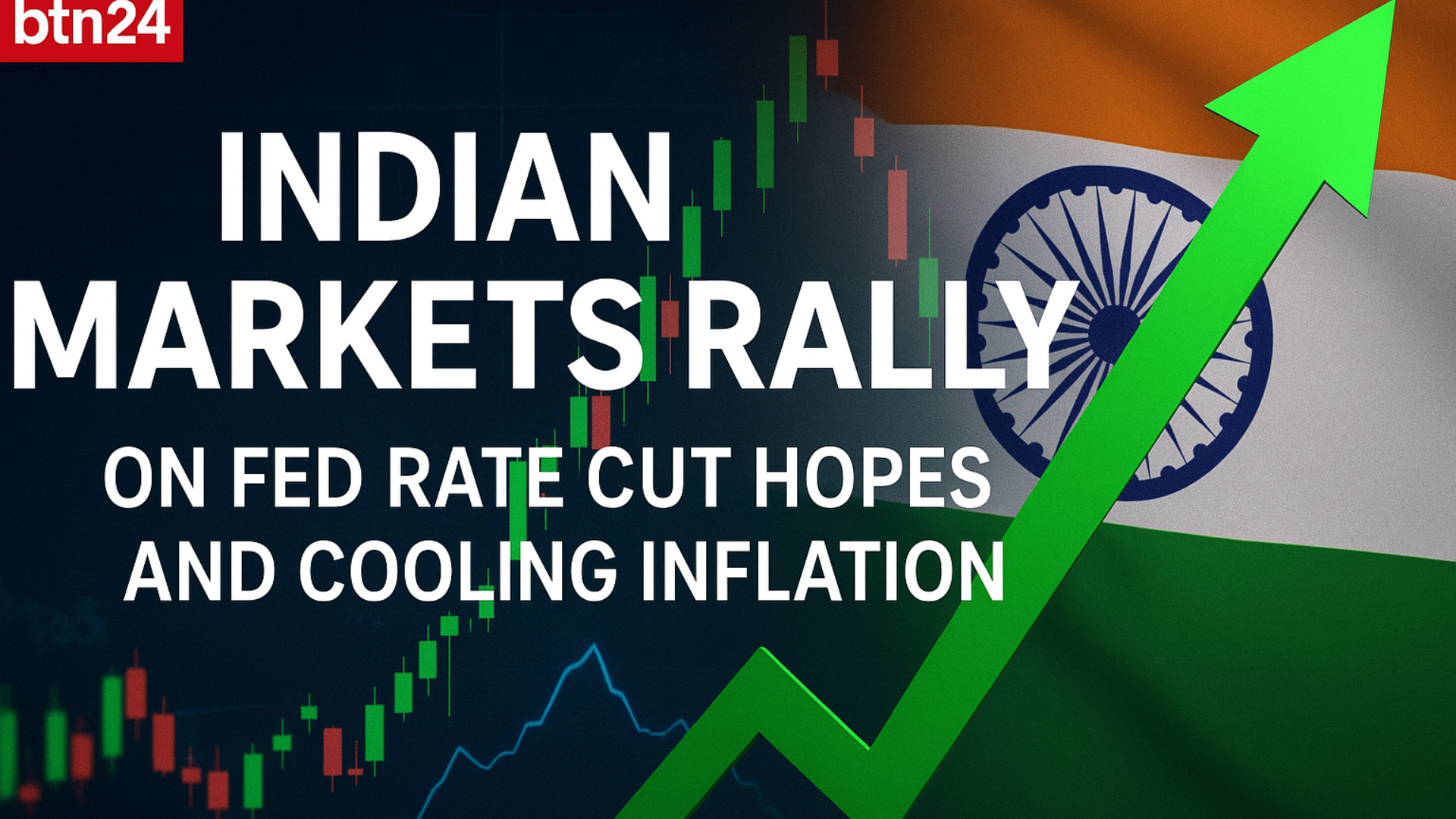
    Indian Markets Rally on Fed Rate Cut Hopes and Cooling Inflation

    Sensex jumps 304 points, Nifty crosses 24,600 as investor sentiment turns bullish

    New Delhi, August 14, 2025
    The Indian stock market ended Wednesday’s session on a strong note, propelled by optimism over potential U.S. Federal Reserve rate cuts and the sharp cooling of domestic retail inflation to an eight-year low. The rally was broad-based, with key indices hitting fresh highs, metal and auto stocks leading the charge, and investor wealth swelling by over ₹2 lakh crore in a single day.


    A Day of Strong Gains

    The BSE Sensex surged 304 points, or 0.40%, to close at 81,157.32, while the NSE Nifty 50 climbed 131.95 points (0.54%) to settle at 24,610.15. Both indices opened in the green, sustained momentum throughout the day, and closed near their intraday highs.

    Market breadth favored the bulls — 1,890 shares advanced, 1,420 declined, and 102 remained unchanged on the Bombay Stock Exchange. The Nifty Midcap 150 and Nifty Smallcap 250 outperformed the benchmarks, closing 0.5% and 0.6% higher respectively, underscoring the strength in broader markets.


    Why the Markets are Rising

    1. Cooling U.S. Inflation

    July’s U.S. retail inflation data came in lower than expected, sparking hopes that the Federal Reserve could cut interest rates as early as September. The softer inflation figure eased concerns about prolonged monetary tightening, leading to a global rally that spilled over into Indian equities.

    2. Domestic CPI at 8-Year Low

    Closer to home, India’s Consumer Price Index (CPI) inflation cooled to 1.55% in July, its lowest since 2017, comfortably within the Reserve Bank of India’s target band of 2–6%. Economists believe this could give the RBI additional room to maintain a supportive monetary stance, further bolstering market sentiment.

    3. Strong Sectoral Performance

    • Metals: Riding on higher commodity prices and expectations of renewed infrastructure demand.
    • Auto: Benefiting from steady retail sales and easing input costs.
    • Healthcare & Pharma: Gaining on defensive buying and export optimism.
    • Financials: Supported by healthy quarterly earnings and lower credit cost forecasts.

    Top Gainers and Losers

    Among the Nifty 50 constituents:

    • Top gainers: Tata Steel (+3.2%), JSW Steel (+2.9%), Bajaj Auto (+2.4%), Sun Pharma (+2.3%), and ICICI Bank (+2.1%).
    • Top losers: Tech Mahindra (-1.2%), Infosys (-0.9%), and HCL Tech (-0.7%), as IT stocks saw mild profit-taking following recent gains.

    Investor Wealth Swells

    The sharp rally added an estimated ₹2.05 lakh crore to investor wealth in a single day, with the BSE market capitalization crossing the ₹460 lakh crore mark. Analysts say the market is benefitting from a “Goldilocks” macroeconomic environment — moderate inflation, robust corporate earnings, and supportive global cues.


    SEBI’s Regulatory Push

    On the regulatory front, the Securities and Exchange Board of India (SEBI) proposed new guidelines to formally integrate algorithmic and proprietary trading within stockbroker regulations. The move aims to enhance transparency, curb potential misuse of high-frequency trades, and strengthen oversight. Public feedback on the draft framework has been invited until September 3, 2025.


    Global Market Influence

    Indian equities tracked gains across Asia, where markets rallied on the back of dovish central bank expectations.

    • Japan’s Nikkei 225 climbed 0.6%
    • Hong Kong’s Hang Seng advanced 1.2%
    • China’s Shanghai Composite rose 0.5%

    In the U.S., futures pointed to a higher open for Wall Street indices, with traders pricing in a 70% probability of a Fed rate cut next month.


    Expert Views

    Radhika Shah, Senior Analyst at Axis Securities, told btn24:

    “Cooling inflation both in India and the U.S. has come as a double dose of positive news. This environment could support further gains in Indian equities, but investors should remain cautious of global geopolitical developments that could trigger volatility.”

    Amitabh Sinha, Head of Research at Capital Edge, added:

    “While today’s rally is encouraging, the market has run up considerably. We expect some profit-booking at higher levels, but the medium-term outlook remains bullish as long as macro indicators stay supportive.”


    What This Means for Investors

    For retail investors, the current rally offers opportunities but also warrants discipline:

    • Avoid chasing stocks that have already surged sharply in recent sessions.
    • Focus on sectors with strong earnings visibility such as banking, autos, and select metals.
    • Maintain a diversified portfolio to manage risk.

    Outlook for the Coming Weeks

    Market watchers expect the Nifty to test 24,800–25,000 levels in the short term if global cues remain favorable. Any sharp reversal in U.S. interest rate expectations or a spike in crude oil prices could, however, dampen the bullish momentum.


    Bottom Line:
    The Indian stock market’s rally on August 13, 2025, reflects a rare alignment of domestic and global positives. With inflation cooling and hopes of a U.S. rate cut rising, investors are riding a wave of optimism — one that could carry equities to new record highs in the weeks ahead.

  • ⚡ JP Power Rockets Over 15% — A Surge Backed by Big Moves and Bigger Hopes

    ⚡ JP Power Rockets Over 15% — A Surge Backed by Big Moves and Bigger Hopes

    Mumbai | July 7, 2025

    In a day that lit up the trading screens, Jaiprakash Power Ventures Ltd (JP Power) delivered a dramatic show at the markets, soaring over 15% intraday. It wasn’t just a lucky bounce — this rally was powered by real news, real action, and a sense of renewed belief among investors.

    Two major developments turned up the heat:

    • A high-stakes acquisition bid from none other than the Adani Group for JP Power’s parent company, and
    • A strong and confidence-boosting Annual General Meeting (AGM) held over the weekend.

    By the closing bell, JP Power was just a breath away from its 52-week high, with over 50 million shares traded on the BSE alone — an electrifying reminder of the buzz building around the company.


    🚨 What’s Driving the Buzz?

    1. Adani Steps In — and Everyone’s Watching

    Whispers turned into headlines when news broke that the Adani Group has emerged as the front-runner in a ₹12,500 crore bid to acquire Jaiprakash Associates (JP Associates) — the parent company of JP Power.

    The deal reportedly includes ₹8,000 crore in upfront cash. That’s not small change — that’s strategic muscle.

    Now here’s the kicker: JP Power holds a 24% stake in JP Associates. So if Adani takes control, it could mean serious shifts in structure, synergy, and valuation.

    “If Adani successfully acquires JP Associates, we’re looking at a massive value unlock for JP Power. Synergies between cement and power assets could be game-changing,” said G. Chokkalingam, Founder of Equinomics Research.

    In short: this isn’t just about a deal. It’s about a possible transformation.


    2. AGM That Hit the Right Notes

    While the takeover talk made headlines, the company’s 30th AGM on July 5 brought in substance. Held virtually, the meeting wasn’t flashy — but it was firm.

    Highlights included:

    • Adoption of audited financials for FY 2024–25
    • Reappointment of directors and auditors
    • Reassuring signals from leadership

    Investors left with more clarity and, more importantly, more confidence. And in a market that thrives on sentiment, that confidence counts.


    📊 What the Charts Say

    • Price Action: Up over 15% intraday, with the stock trading well above all its key moving averages.
    • Volume: ~50 million shares changed hands — nearly 6x the usual average.
    • RSI: Nearing 70 — technically approaching “overbought,” but with momentum this strong, that could be fuel, not friction.

    If the momentum holds, the next resistance lies around ₹23.75 to ₹24.50. That’s within reach.


    💰 Financial Snapshot: FY 2024–25

    MetricValue
    Revenue₹1,366.7 crore (vs ₹1,863.6 cr YoY)
    Net Profit (Q4)₹155.7 crore (↓ 73% YoY)
    Net Profit (FY25)₹813.6 crore (↓ from ₹1,022 cr)
    Market Capitalization~₹14,800 crore
    P/E Ratio~18.1x
    P/B Ratio~1.06x
    ROCE / ROE10.3% / 6.8%

    Yes, profits dipped — but the market seems to be betting on what’s coming, not just what’s behind.


    🏗️ The Bigger Picture: JP Associates and the Battle for Control

    JP Associates, deep in insolvency resolution, has attracted some big names:

    • Adani Group
    • Vedanta
    • Dalmia Bharat
    • Jindal Power
    • PNC Infratech

    Creditors have already turned down a late offer from the Suraksha Group due to timing issues — tightening the field. With over ₹57,000 crore in creditor claims, this is one of the bigger battles in India Inc’s debt saga.

    And JP Power is right in the middle of it.


    🔭 What’s Next?

    ✔️ Outcome of the Adani bid — the single most critical trigger
    ✔️ Q1 FY26 earnings — especially debt handling and growth momentum
    ✔️ Technical breakouts — does ₹24 break or bounce?
    ✔️ Sector outlook — how energy & infra shape post-election policy


    💬 Expert Take:

    “This is a textbook re-rating story. JP Power was written off by many — but this may be the comeback script. If the Adani deal clicks, we’re looking at a long-term breakout,” said a Mumbai-based fund manager on condition of anonymity.


    📌 Bottom Line

    JP Power isn’t just rising — it’s rewriting the narrative. From being seen as a struggling power stock, it’s now turning heads on Dalal Street with serious momentum, strategic headlines, and strong backing.

    Whether this surge sustains or pauses for breath, one thing’s clear: JP Power is back on the radar.


    Disclaimer: This article is for informational purposes only. Always consult a qualified financial advisor before making investment decisions.

  • Stock Picks for July 4: UPL & Chennai Petroleum Look Promising

    Stock Picks for July 4: UPL & Chennai Petroleum Look Promising

    Image Credit: Mohamed Hassan / Pixabay

    If you’re tracking the markets this week, keep an eye on UPL and Chennai Petroleum Corporation. According to a recent report by Bajaj Broking Research, both stocks show strong potential for short-term gains.

    The brokerage suggests buying UPL in the ₹670–₹690 range, with a target price of ₹747. The stock has been showing steady momentum, supported by positive market sentiment.

    For Chennai Petroleum, the recommended buy range is ₹700–₹720, aiming for a target of ₹787. Analysts point to strong fundamentals and improving performance in the oil & gas sector as key drivers.

    This comes as the Nifty 50 touched a new nine-month high of 25,669, driven by broad-based market participation and growing investor confidence.

    Note: These are expert suggestions, not financial advice. Always do your own research or talk to a professional before investing.

  • 💱 Rupee Set to Slip Against Dollar as U.S. Jobs Data Shakes Fed Rate Cut Hopes

    💱 Rupee Set to Slip Against Dollar as U.S. Jobs Data Shakes Fed Rate Cut Hopes

    Image by Rupixen on Pixabay

    July 4, 2025 — New Delhi
    India’s currency markets are bracing for a slide in the rupee today, as stronger-than-expected U.S. employment data signals a potential pause in the Federal Reserve’s rate-cut plans—strengthening the dollar and pressuring emerging market currencies.

    According to currency dealers and early market projections, the rupee is likely to open in the ₹85.46–₹85.50 range, down from Thursday’s closing level of ₹85.31 per U.S. dollar.

    “U.S. job growth is outpacing expectations. This has triggered a rally in the dollar index and reduced chances of a July rate cut,” said a senior forex analyst at Mumbai-based investment firm.

    🔍 What Triggered the Slide?

    The catalyst was the June non-farm payrolls report from the United States, which showed employment gains far stronger than forecast. This upbeat data led to:

    • Rising U.S. Treasury yields
    • A sharp rebound in the dollar
    • A sell-off in riskier assets, including emerging market currencies like the rupee

    📉 Market Sentiment & Outlook

    • Traders now believe the rupee could test its support zone at ₹85.30, with further weakness if dollar strength continues.
    • Forward premiums have also eased slightly, indicating a cautious medium-term outlook.
    • The Reserve Bank of India is expected to monitor the situation closely, but no direct intervention is anticipated unless volatility spikes.

    “The global sentiment is clearly dollar-positive for now. The rupee will remain under pressure until the Fed gives more clarity on its stance,” said a currency strategist at a public-sector bank.


    📊 What It Means for India

    • Importers may face rising costs in the short term, particularly for crude oil and electronics
    • Exporters, especially in IT and textiles, may benefit from better conversion rates
    • Investors are advised to stay cautious in forex-linked instruments
  • 💰 RBI Announces ₹1 Lakh Crore Reverse Repo Auction to Absorb Surplus Liquidity

    💰 RBI Announces ₹1 Lakh Crore Reverse Repo Auction to Absorb Surplus Liquidity

    Image credit: Nikola Tomašić / Unsplash

    In a calibrated step to manage surplus liquidity in the financial system, the Reserve Bank of India (RBI) has announced a ₹1 lakh crore seven-day variable rate reverse repo (VRRR) auction, scheduled for Friday, July 4.

    The decision comes as surplus liquidity in the banking sector touched approximately ₹3.75 lakh crore on July 2, prompting the central bank to act swiftly to bring short-term interest rates closer to the policy repo rate of 5.5%.

    “On a review of the current and evolving liquidity conditions, it has been decided to conduct a Variable Rate Reverse Repo auction on July 4,” the RBI said in its official communication.

    The RBI also cancelled a previously planned 14-day VRRR operation, replacing it with this shorter-term measure to better align with its liquidity management strategy.

    🔍 Why It Matters:

    • The reverse repo auction enables banks to temporarily park their excess funds with the RBI, helping drain out surplus money from the system.
    • It is a critical tool to control volatility in overnight rates like the call money rate and MIBOR.
    • The move indicates the RBI’s intent to maintain financial stability without altering its policy stance.

    Market participants view the central bank’s action as a sign of its proactive approach in fine-tuning monetary operations while keeping inflation risks and interest rate alignment in check.

    This marks the first major liquidity absorption move of this scale since November 2024, reinforcing the RBI’s focus on orderly money market functioning.

  • 🇮🇳 Rupee Strengthens to One-Month High on Trade Deal Optimism

    🇮🇳 Rupee Strengthens to One-Month High on Trade Deal Optimism

    Image Credit: Unsplash

    The Indian rupee surged to a one-month high on Wednesday, closing at ₹85.31 against the U.S. dollar, driven by strong foreign fund inflows and growing confidence in a potential interim trade agreement between India and the United States.

    Market sentiment turned positive as negotiators from both countries in Washington showed signs of progress ahead of the July 9 tariff deadline. The possibility of a last-minute deal—expected to ease duties and improve access for key Indian exports—has boosted investor confidence.

    Analysts say the rally reflects broader optimism around India’s external trade outlook and signals strengthening macroeconomic fundamentals.

    “The rupee’s rally is supported by inflows, strong FX reserves, and hopes of a resolution on trade tariffs,” said a senior currency strategist at a Mumbai-based bank.

    The Reserve Bank of India (RBI) has so far refrained from aggressive intervention, allowing the currency to benefit from global risk-on sentiment.